Introduction
If a dishwasher is not filling correctly or is overfilling with water, the float switch may be the cause. Testing the float switch helps determine whether the component is working properly.
A float switch test usually requires only basic tools and can often be completed in a short amount of time. Confirming whether the switch works correctly helps determine if cleaning, adjustment, or replacement is necessary.
What This Means
The float switch is an electrical component that responds when the float inside the dishwasher rises with the water level.
When the float reaches the correct height, it presses a lever that activates the float switch underneath the dishwasher. The switch then signals the dishwasher to stop filling with water.
Testing the switch checks whether the internal contacts are opening and closing properly when the float moves.
Tools Needed for Testing
Most float switch tests require only a few basic tools.
Common tools include:
• A multimeter with continuity testing
• A screwdriver to remove the lower access panel
• A flashlight for visibility under the dishwasher
A towel may also be helpful if there is moisture around the base of the appliance.
Step 1: Disconnect Power
Before working on any appliance, disconnect electrical power.
This can usually be done by:
• Unplugging the dishwasher from the outlet
• Turning off the dishwasher circuit breaker
Never test electrical components while the appliance is connected to power.
Step 2: Locate the Float Switch
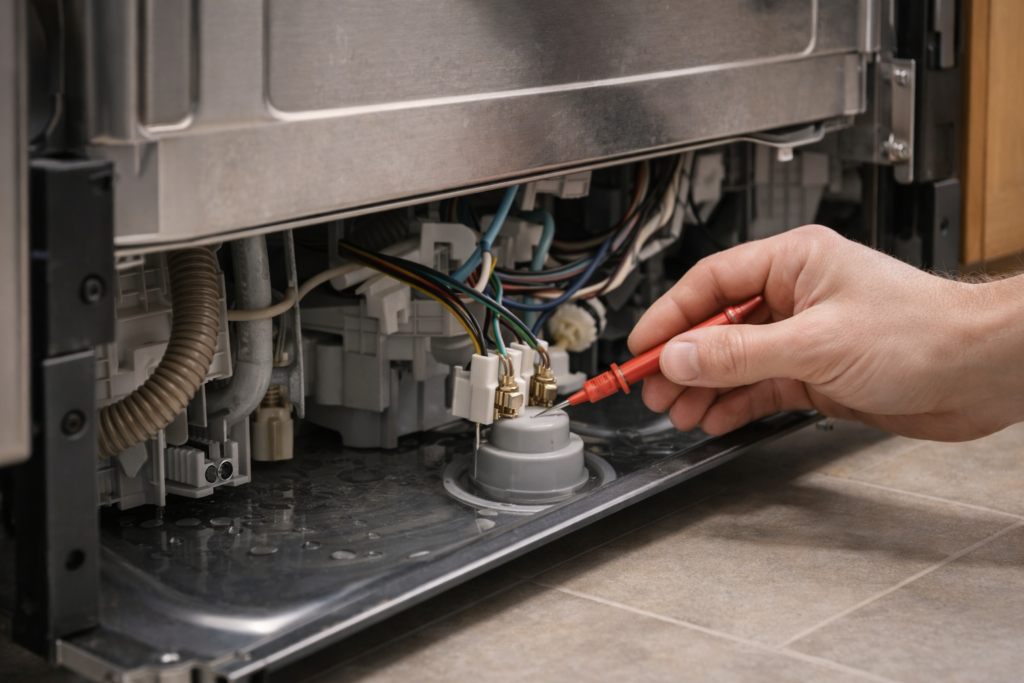
The float switch is normally located underneath the dishwasher tub directly below the float assembly.
To access it:
-
Remove the lower access panel at the bottom front of the dishwasher.
-
Look underneath the area where the float sits inside the tub.
-
Identify the small switch with two electrical wires attached.
The float inside the dishwasher connects mechanically to this switch.
If you need help identifying it, see Where Is the Float Switch Located in a Dishwasher?
Step 3: Disconnect the Switch Wires
Once the switch is visible, disconnect the electrical connectors attached to the terminals.
Pull the connectors gently using needle-nose pliers if necessary. Avoid pulling on the wires themselves.
Disconnecting the wires allows you to test the switch without interference from the dishwasher circuitry.
Step 4: Test the Switch With a Multimeter
Set the multimeter to the continuity or resistance setting.
Then:
-
Place one probe on each terminal of the float switch.
-
Move the float inside the dishwasher up and down.
-
Watch the multimeter reading as the float moves.
A working switch should change between open and closed continuity when the float moves.
If the reading does not change, the switch may be faulty.
Step 5: Inspect the Float Movement
Sometimes the float switch appears faulty when the real problem is the float itself.
Check that the float inside the dishwasher:
• Moves up and down freely
• Is not blocked by debris
• Is not stuck in the raised position
Food particles or mineral buildup can prevent the float from activating the switch properly.
When the Float Switch Needs Replacement
Replacement may be necessary if:
• The switch does not change continuity during testing
• The switch remains permanently open or closed
• The switch is physically damaged
• The dishwasher repeatedly overfills or fails to fill
Float switches are relatively inexpensive and usually straightforward to replace.
If replacement is required, compatible parts vary depending on the dishwasher model.
For a full overview of symptoms, testing, location, and replacement, see the Complete Guide to Dishwasher Float Switches.
Related Guides
Where Is the Float Switch Located in a Dishwasher?
How to Replace a Dishwasher Float Switch
Why a Dishwasher Float Switch Keeps Failing